Discover the timeless beauty rituals of ancient Egypt, Greece, India, and China. Explore how natural ingredients like honey, clay, oils, and herbs shaped legendary beauty traditions that still inspire skincare today.
From the banks of the Nile to the palaces of Mesopotamia and the temples of ancient India, beauty in antiquity was far more than skin-deep—it was ritual, identity, power, and an art grounded in nature. Across these early civilizations, women (and men) crafted beauty regimes using herbs, clays, oils, and resins gifted by the earth, forming a legacy of natural skincare that still echoes in modern routines. Among these cultures, ancient Egypt stands out as a luminous beacon, where beauty was sacred, aesthetic, and medicinal. Yet it was not alone. Greece, Rome, India, and China all offer fascinating insight into how natural elements shaped beauty standards—and legends.
Egypt: The Birthplace of Ritualized Beauty
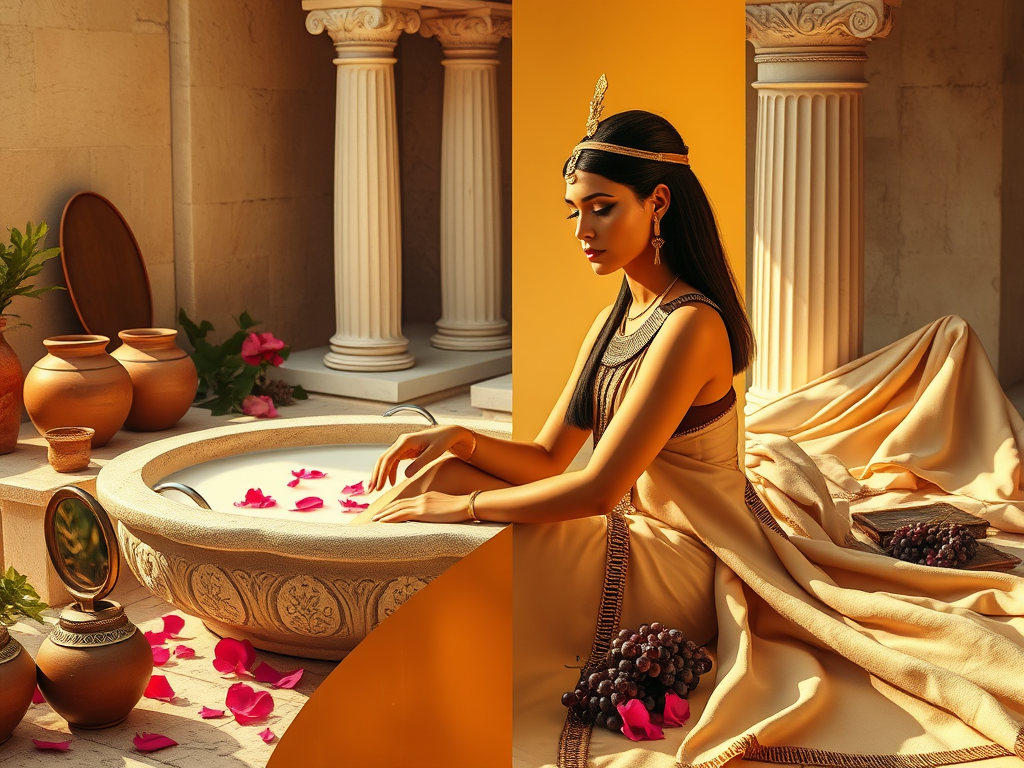
In ancient Egypt, beauty was divine. The goddess Hathor was the embodiment of love and adornment, and women sought to mirror her image through meticulous self-care. Cleopatra VII, perhaps the most famous queen of beauty in history, turned her bathing rituals into legend. Historical texts and archaeological finds suggest she bathed in milk—likely donkey’s milk—combined with honey and herbs like lavender or rose petals. The lactic acid in milk acted as a gentle exfoliant, while honey’s antibacterial properties helped preserve youthful skin.
But Egyptian beauty was not reserved for royalty. Women of all classes used kohl—a black eyeliner made from ground galena (a natural mineral) mixed with fat or oils—not just for aesthetic allure but for eye protection from the desert sun and infections. Red ochre, a natural clay pigment, was crushed and mixed with fat to stain lips and cheeks. Their “lotions” were often made with castor oil, moringa oil, or sesame oil, known for their emollient and healing properties.
Henna, derived from the Lawsonia inermis plant, was used to dye hair, nails, and hands. It symbolized not only beauty but protection and blessing. Even the dead were adorned with henna, makeup, and perfume before burial, as beauty was part of eternal dignity.
Greece and Rome: Refinement and Balance
The Greeks revered harmony and balance in both physique and skin. They used olive oil not just for cooking but as a moisturizer, hair gloss, and even a base for perfumes. Greek women often applied honey and yogurt masks for hydration and skin clarity—a tradition that persists in Mediterranean cultures to this day.
In Rome, where wealth and status heavily influenced beauty practices, women bathed in aromatic waters steeped with rose petals, herbs, and even crocodile dung—a peculiar yet popular exfoliating agent. Clay masks using red and white clays were applied to lighten the skin, considered a symbol of high status and nobility.
They also made use of crushed pearls, sea salts, and vinegar in various facial applications. Roman women bleached their hair with natural sun exposure, sometimes enhanced by lemon juice, creating a golden hue that aligned with idealized notions of beauty.
India: Ayurveda and the Sacred Science of Skin
In India, beauty was—and remains—deeply entwined with Ayurveda, a holistic system of medicine dating back more than 3,000 years. The skin was seen as a reflection of internal health, and natural ingredients were central to beautification.
Turmeric, renowned for its anti-inflammatory and brightening properties, was mixed with milk, sandalwood, and chickpea flour in pre-wedding rituals still practiced today. Neem leaves were ground into pastes to treat acne and purify the skin. Oils like sesame and coconut were used for “abhyanga”—the ritual of self-massage—believed to rejuvenate both body and soul.
Henna was again prevalent, not only for body art but also as a conditioner and dye for hair. Kajal (a form of kohl) lined the eyes, and rosewater was widely used as a toner. These practices were deeply spiritual and medicinal, designed to maintain the doshas—or energies—of the body in balance.
China: Subtle Elegance and Herbal Science
Ancient Chinese beauty philosophy centered on achieving an ethereal glow—a “jade-like” complexion. Ginseng, pearl powder, and white lotus were commonly used for their anti-aging and whitening effects. Herbal compresses and infused teas supported inner vitality, which was believed to reflect outwardly.
Rice water, rich in amino acids and vitamins, was used to soften and brighten the skin—much like it is today in Korean and Japanese skincare. Hair was nourished with camellia oil and combed daily with wooden tools to stimulate circulation.
Legacy of Legends
These ancient civilizations laid the groundwork for what we now call natural beauty. They teach us that beauty is not simply about appearance—it is about health, ritual, intention, and harmony with nature. The legacies of Cleopatra, the goddesses of India, the empresses of China, and the noblewomen of Greece endure not just in stories but in the continued reverence for nature-based skincare.
In an age where consumers increasingly seek clean, plant-based alternatives, these rituals resonate anew. They remind us that long before synthetic serums and lab-grown elixirs, the world’s most legendary beauties turned to the earth—and found radiance in its simplest gifts.
 Spino Blog | Clean Beauty, Naturally
Leave a comment